
Cleaning Towels 101: The Commercial Buyer’s Guide to Disposable, Reusable & Microfiber Options
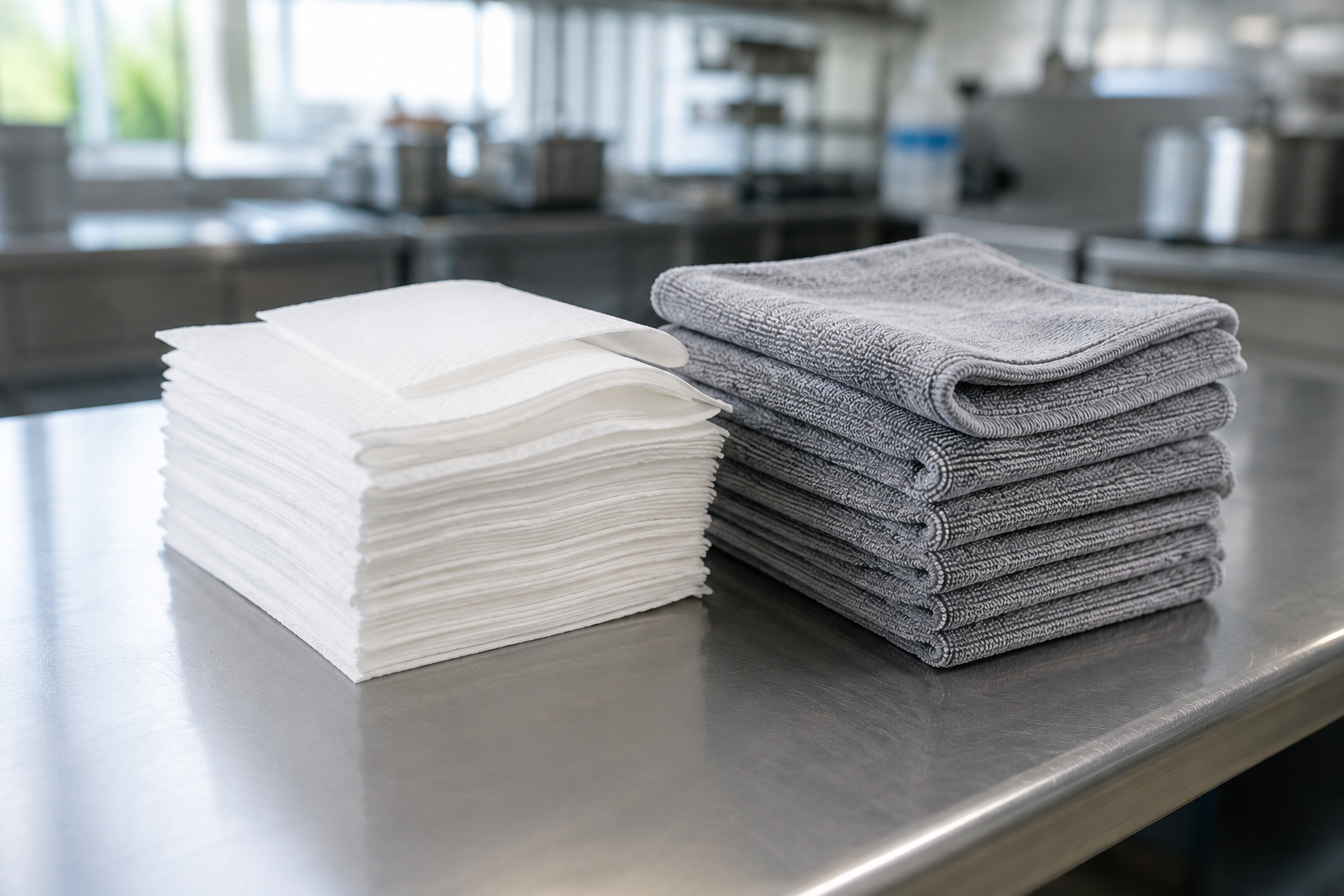
Every commercial cleaning routine comes down to a few core tools, and cleaning towels sit right at the center of that list. They’re the item staff reach for dozens of times a shift wiping counters, drying hands, cleaning glass, sanitizing equipment yet most businesses give surprisingly little thought to which type they’re actually buying. The result is often mismatched products, unnecessary waste, and cleaning tasks that take longer than they should.
This guide walks through the different types of cleaning towels available for commercial use, where each one performs best, and how to buy them the way an experienced facility manager would.
Why the Right Cleaning Towels Matter for Commercial Operations
In a home setting, one towel can handle almost any job. In a commercial environment, that approach breaks down fast. A restaurant kitchen, a hotel housekeeping cart, and a janitorial closet all have different demands different surfaces, different contamination risks, different volume of use. Cleaning towels designed and rated for commercial use hold up to that demand in ways household products simply aren’t built for.
Getting this right isn’t just about performance. It affects labor time, product waste, and in food-service settings, compliance with health and sanitation standards.
Cleaning Cloths vs. Cleaning Towels: What’s the Difference?
The terms are often used interchangeably, but there’s a practical distinction worth understanding. Cleaning cloths tend to refer to smaller, general-purpose wiping materials, while cleaning towels especially commercial cleaning towels are often larger and built for more demanding, repeated wiping tasks. Non-woven cleaning cloths fall into their own category: engineered fabric-like material (rather than woven cotton or microfiber) designed for absorbency and durability in a single or limited-use format. Understanding which category a product falls into helps when comparing options across suppliers.
Benefits of Cleaning Towels
A well-chosen cleaning towel does more than wipe a surface. In a commercial setting, the benefits compound across every shift:
- Faster cleaning cycles — the right towel absorbs and lifts debris in fewer passes, saving staff time across a full shift
- Reduced cross-contamination risk — using dedicated cleaning towels for specific zones (kitchen, restroom, general areas) limits the spread of bacteria between surfaces
- Lower long-term cost — reusable cleaning towels, particularly microfiber cleaning cloths, can be laundered hundreds of times, spreading the cost over a much longer usable life
- Better surface results — microfiber cleaning cloths in particular reduce streaking on glass and stainless steel compared to standard cotton rags
- Consistency across staff and shifts — standardizing on specific cleaning towels makes training simpler and results more predictable
Disposable vs. Reusable Cleaning Towels
This is the single biggest decision most buyers face, and the right answer depends heavily on where and how the towels will be used.
Disposable cleaning towels are single-use or limited-use products, often made from non-woven cleaning cloths material. They’re popular in food-service environments where cross-contamination risk needs to be minimized and laundering isn’t practical between uses. Disposable cleaning towels are also useful for spill response, one-time cleanups, and situations where a towel might pick up chemicals or contaminants you don’t want re-entering a laundering cycle.
Reusable cleaning towels, including microfiber cleaning cloths, are designed to be laundered and used repeatedly. They typically cost more per unit upfront but deliver a lower cost-per-use over time, since a single quality microfiber cloth can replace dozens of disposable towels across its lifespan. Reusable options are a strong fit for general-purpose cleaning, glass and stainless steel surfaces, and any high-frequency task where laundering is already part of the operational workflow.
Many commercial operations use both: disposable cleaning towels for food-contact and high-risk zones, and reusable cleaning towels for general facility maintenance where laundering is straightforward.
Kitchen Cleaning Towels: A Category of Their Own
Kitchen cleaning towels deserve special attention because food-service environments carry the highest stakes for cross-contamination and sanitation compliance. Kitchen cleaning towels need to be low-lint, food-safe, and in most operations color-coded or otherwise separated from towels used in restrooms or general areas. Many kitchens rely on a rotation system where kitchen cleaning towels are laundered or replaced on a strict schedule rather than judged by appearance alone.
Where Commercial Cleaning Towels Are Used
Commercial cleaning towels show up across nearly every type of facility, though the specific product often changes by setting:
- Restaurants and food service — kitchen cleaning towels for prep surfaces, equipment wipe-downs, and spill response
- Hotels and hospitality — reusable cleaning towels and microfiber cleaning cloths for guest rooms, glass, and high-touch surfaces
- Offices and corporate facilities — general-purpose cleaning cloths for desks, break-rooms, and shared equipment
- Healthcare-adjacent and high-hygiene environments — disposable cleaning towels to reduce contamination risk between uses
- Retail and grocery — commercial cleaning towels for checkout counters, displays, and high-touch customer areas
- Industrial and warehouse settings — heavy-duty janitorial cleaning towels for equipment and surface maintenance
How to Choose the Right Cleaning Towels
With so many options, narrowing down the right cleaning towels for a specific facility comes down to a few practical questions.
What surface is being cleaned? Glass and stainless steel benefit most from microfiber cleaning cloths, which reduce streaking. Food-prep surfaces often call for kitchen cleaning towels rated for food contact.
How often will they be used? High-frequency tasks favor reusable cleaning towels for cost efficiency, while occasional or high-risk tasks are often better served by disposable cleaning towels.
Is laundering realistic in your operation? Reusable cleaning towels only deliver their cost advantage if there’s a reliable laundering process in place. Without one, disposable cleaning towels may be the more practical choice.
What’s the contamination risk? Environments with strict sanitation requirements often lean toward disposable cleaning towels or non-woven cleaning cloths to avoid any risk of cross-contact between cleaning cycles.
What’s your total order volume? Facilities buying at scale should look at commercial cleaning towels sold in bulk cases, where per-unit cost drops significantly compared to small retail packs.
Best Practices for Using Cleaning Towels in a Commercial Setting
- Color-code by zone. Assign specific colors of cleaning cloths to kitchens, restrooms, and general areas to prevent cross-contamination.
- Set a laundering schedule for reusable cleaning towels. Don’t rely on visual inspection alone launder on a fixed schedule to maintain hygiene standards.
- Store cleaning towels properly between uses. Damp towels left balled up breed bacteria; hang or store them to dry fully between cleaning cycles.
- Retire worn microfiber cleaning cloths. Once a microfiber towel loses its texture or absorbency, its cleaning performance drops even if it still looks usable.
- Match towel type to task, not convenience. Grabbing whatever cleaning towel is closest, rather than the one suited to the surface, is a common source of inconsistent results.
- Train staff on proper use. Consistent results across shifts depend on staff understanding which cleaning towels go where and why.
Common Mistakes to Avoid
- Using the same cleaning towel across multiple zones. This is one of the fastest ways to spread contamination between kitchen, restroom, and general-use areas.
- Treating reusable cleaning towels as disposable. Discarding microfiber cleaning cloths after minimal use erases the cost savings they’re meant to deliver.
- Buying based on price per unit instead of cost per use. A cheaper cleaning cloth that wears out fast or performs poorly often costs more over time than a slightly pricier, more durable option.
- Skipping non-woven cleaning cloths for spill response. General-purpose towels aren’t always ideal for chemical spills or one-time contamination events non-woven cleaning cloths are often a better fit.
- under-stocking kitchen cleaning towels. Running short during a busy shift forces staff to improvise with the wrong product, increasing sanitation risk.
- Ignoring bulk purchasing for high-volume facilities. Buying commercial cleaning towels in small quantities at retail pricing adds unnecessary cost for operations with predictable, high-volume usage.
Buying Guide: What to Look for When Purchasing Cleaning Towels
When evaluating cleaning towels for a commercial account, look beyond the sticker price:
- Material type — cotton, microfiber, or non-woven cleaning cloths each perform differently depending on the task
- Absorbency and lint level — especially important for kitchen cleaning towels and glass-cleaning applications
- re-usability — confirm whether a product is designed as reusable cleaning towels or intended for single use
- Case size and unit cost — commercial cleaning towels bought by the case typically offer better cost-per-unit than smaller packs
- Certifications or food-safety ratings — relevant for any kitchen cleaning towels used near food-contact surfaces
- Supplier consistency — a janitorial supplies provider that reliably stocks core cleaning supplies avoids mid-month shortages
FAQs
1. What are cleaning towels used for in commercial settings? Cleaning towels are used across commercial facilities for wiping surfaces, drying equipment, cleaning glass, and general janitorial tasks throughout daily operations.
2. What’s the difference between disposable and reusable cleaning towels? Disposable cleaning towels are designed for single or limited use, while reusable cleaning towels, such as microfiber cleaning cloths, are built to be laundered and used repeatedly.
3. Are microfiber cleaning cloths better than regular cleaning cloths? For most surfaces, microfiber cleaning cloths outperform standard cleaning cloths by trapping more debris and reducing streaking, particularly on glass and stainless steel.
4. What are non-woven cleaning cloths? Non-woven cleaning cloths are engineered fabric-like materials, distinct from woven cotton or microfiber, commonly used for absorbent, limited-use cleaning tasks.
5. Why do commercial kitchens need dedicated kitchen cleaning towels? Kitchen cleaning towels are designed to be low-lint and food-safe, reducing cross-contamination risk on food-prep surfaces compared to general-purpose cleaning towels.
6. How many times can reusable cleaning towels be washed? Quality reusable cleaning towels, especially microfiber cleaning cloths, can typically be laundered hundreds of times before their performance noticeably declines.
7. Should businesses use both disposable and reusable cleaning towels? Many commercial operations use disposable cleaning towels for high-risk or food-contact tasks and reusable cleaning towels for general-purpose cleaning.
8. What should I look for when buying commercial cleaning towels in bulk? Focus on material type, absorbency, re-usability, and case pricing to ensure your commercial cleaning towels deliver value at the volume your facility actually uses.
9. Do janitorial cleaning towels need to be color-coded? Color-coding janitorial cleaning towels by zone kitchen, restroom, general areas is a widely used best practice to reduce cross-contamination.
10. Where can I buy commercial cleaning towels and cleaning supplies? Foxhole Depot supplies cleaning towels, janitorial supplies, and commercial cleaning supplies in bulk quantities for U.S. businesses of every size.
Conclusion
Cleaning towels look like a small line item on a supply order, but the decisions behind them disposable versus reusable, microfiber versus standard cloth, color-coded by zone or not have a real effect on cleaning results, labor time, and sanitation compliance. Businesses that treat cleaning towels as a category worth planning around, rather than a generic supply to reorder without much thought, consistently get more consistent results out of every shift.
CTA
Stock your facility with cleaning towels built for commercial use. Shop disposable and reusable cleaning towels, microfiber cleaning cloths, and the full range of janitorial supplies at Foxhole Depot.