
Commercial Kitchen Cleaning Supply Costs: A Complete Budgeting Guide for Restaurant Owners
Introduction
Ask ten restaurant owners how much they spend on janitorial and cleaning supplies every month, and most will guess because it’s rarely tracked as its own line item. It gets buried inside “operating supplies,” reordered re-actively when something runs out, and purchased inconsistently between big-box retail runs and wholesale distributor orders. That inconsistency is expensive. Restaurants that treat cleaning supplies as a planned, forecasted budget category the same way they treat food cost consistently spend less per month than restaurants buying re-actively, while staying better stocked.
This guide breaks down realistic monthly cleaning supply costs by category, explains what drives cost variation between operations, and gives owners and operators a framework for building an accurate cleaning supply budget.
Table of Contents
- Executive Summary
- Direct Answer: What Restaurants Typically Spend
- Deep Educational Content: What Drives Cleaning Supply Costs
- Category-by-Category Cost Breakdown
- Commercial Buying Guide
- Restaurant Use Cases
- Janitorial Use Cases
- Industry Examples
- Comparison Tables
- Pros & Cons of Different Buying Strategies
- Expert Tips for Cutting Costs Without Cutting Corners
- Common Mistakes
- Cost Analysis
- Product Selection Guide
- Frequently Asked Questions
- Conclusion
Executive Summary
A typical full-service independent restaurant spends roughly 1% to 2% of monthly revenue on janitorial and cleaning supplies, though this varies significantly by concept, square footage, and whether the operator buys wholesale or retail. The single biggest cost-saving lever available to most restaurants isn’t switching products — it’s switching purchasing behavior: moving from reactive retail purchases to case-based wholesale ordering with predictable par levels, which typically cuts per-unit costs by 20–40% without any change in product quality.
Direct Answer: What Do Restaurants Spend on Cleaning Supplies?
Monthly cleaning and janitorial supply spend for a mid-size independent restaurant (roughly 2,000–4,000 square feet) typically falls between $300 and $900 per month, covering chemicals, disposable cloths, trash bags, restroom supplies, and general cleaning tools. Quick-service concepts with smaller footprints often spend less in absolute dollars but more per square foot due to higher table-turn and disposable-product usage. Full-service and hospitality operations with larger restroom counts and more surface area typically spend more in absolute terms.
Deep Educational Content: What Drives Cleaning Supply Cost Variation
Several factors explain why two restaurants of similar size can have very different cleaning supply budgets:
- Disposable vs. reusable product mix: a kitchen relying heavily on disposable cleaning cloths and single-use items has a higher recurring supply cost than one investing in reusable microfiber and in-house laundering, though the latter carries labor and equipment costs that don’t show up in the same budget line.
- Purchasing channel: retail big-box purchases are almost always more expensive per unit than case-based wholesale ordering, sometimes significantly so for high-volume items like trash bags and paper products.
- Square footage and restroom count: larger dining rooms and more restrooms directly increase paper product and general cleaning chemical consumption.
- Menu and prep intensity: kitchens with heavy protein prep and grease-generating cooking methods (fryers, grills) consume more de-greaser and floor chemical volume than lighter, less grease-intensive concepts.
- Staff training and waste: kitchens without clear supply protocols tend to over-use chemicals and disposables, inflating costs without improving cleanliness outcomes.
Category-by-Category Cost Breakdown
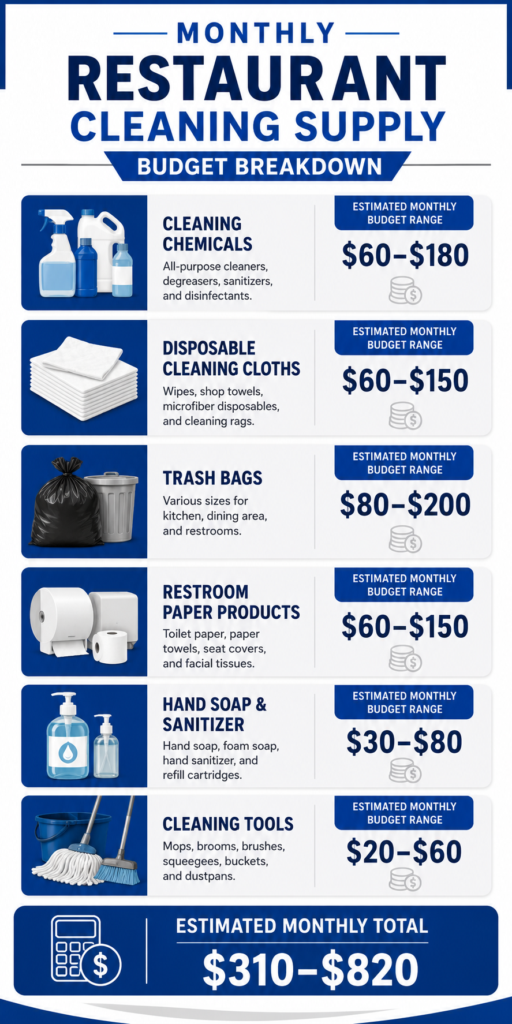
| Category | Typical Monthly Cost (Mid-Size Restaurant) |
|---|---|
| Cleaning chemicals (sanitizer, de-greaser, general cleaners) | $60–$180 |
| Disposable cleaning cloths / towels | $60–$150 |
| Trash bags (kitchen + dining + restroom) | $80–$200 |
| Restroom paper products (toilet paper, hand towels) | $60–$150 |
| Hand soap and sanitizer | $30–$80 |
| Mop heads, brushes, and general tools (replacement cadence) | $20–$60 |
| Estimated Total | $310–$820 |
Concepts with heavier disposable food packaging needs (takeout-forward restaurants) will see additional cost in a related but separate budget category disposable food packaging which is worth tracking apart from janitorial supply spend since it scales with order volume rather than facility size.
Commercial Buying Guide
- Set par levels by category, not by vendor. Know exactly how many cases of trash bags, paper towels, and sanitizer concentrate you use per week before deciding how to buy them.
- Move recurring high-volume items to wholesale case pricing. Trash bags, paper products, and disposable cloths are the categories where wholesale-vs-retail price gaps are largest.
- Consolidate vendors where possible. Ordering chemicals, disposables, and paper products from a single wholesale supplier reduces shipping costs and simplifies inventory tracking compared to splitting purchases across multiple retail and online sources.
- Buy concentrate over per-mixed where volume justifies it. Concentrated chemicals diluted on-site are almost always cheaper per usable gallon than per-mixed spray products, once volume is high enough to justify the dispensing equipment.
- Review usage quarterly, not just price. A cheaper product that requires double the volume to achieve the same result isn’t actually saving money track usage rate alongside unit price.
Restaurant Use Cases
- Quick-service restaurants benefit most from bulk trash bag and disposable cloth purchasing given high table-turn and frequent surface cleaning between orders.
- Full-service restaurants typically see the largest single cost category in restroom paper products and general cleaning chemicals due to larger dining room and restroom footprints.
- Ghost kitchens and delivery-focused operations often have lower janitorial supply costs relative to revenue since dining room and restroom overhead is minimal, but higher disposable packaging costs elsewhere.
- Multi-unit operators achieve the largest percentage savings by consolidating purchasing across locations into standardized case orders from a single wholesale supplier.
Janitorial Use Cases
- Third-party janitorial contractors typically build their own supply cost into service contracts, but restaurant operators supplying their own consumables (trash bags, restroom paper) should track this separately from the labor cost of the contract.
- Overnight and closing cleaning crews are usually the heaviest users of chemical concentrate and disposable cloths, since deep-cleaning tasks concentrate at closing rather than spreading evenly across the day.
- Facilities managers overseeing multiple sites use standardized supply budgets per square foot to flag outlier locations that may be over-ordering or under-stocked.
Industry Examples
food-service operators who move from ad-hoc retail purchasing to planned wholesale case ordering commonly report meaningful reductions in per-unit cleaning supply costs driven primarily by eliminating retail markup and reducing emergency “run to the store” purchases, which are almost always the most expensive way to buy any supply category. Multi-unit restaurant groups in particular benefit from centralizing cleaning supply purchasing the same way they centralize food purchasing, applying the same volume-discount logic to a category that’s often overlooked.
Comparison Tables
Retail vs. Wholesale Purchasing
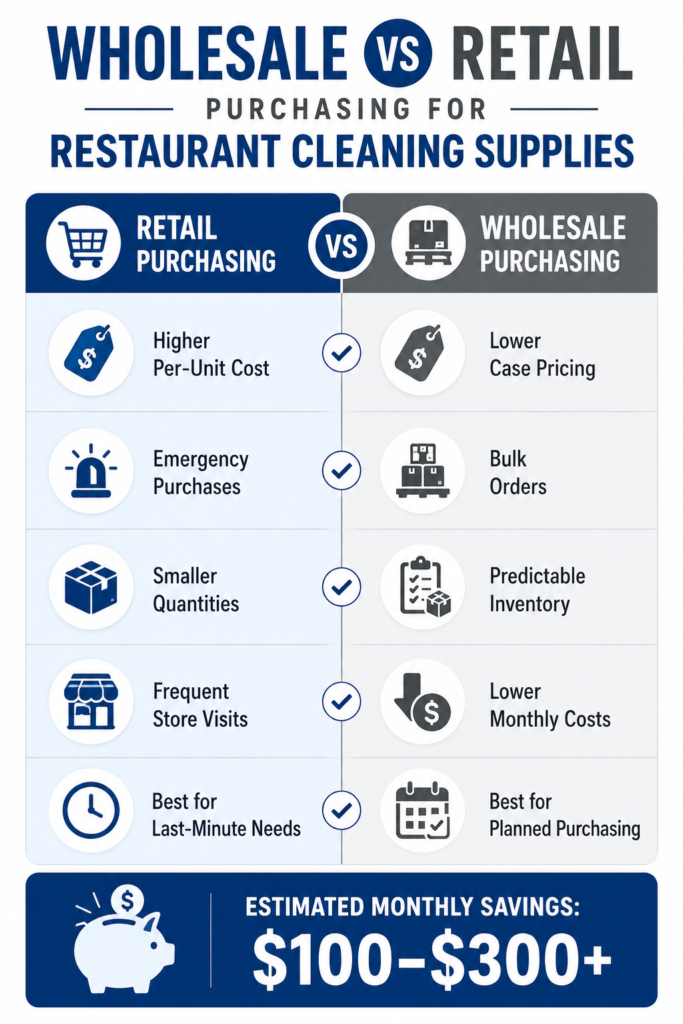
| Factor | Retail (Big-Box / Local Store) | Wholesale (Case-Based Supplier) |
|---|---|---|
| Per-unit cost | Higher | Lower, especially at case volume |
| Convenience for emergency restocks | Higher (immediate pickup) | Lower (requires lead time) |
| Best for | Emergency top-offs, small operations | Planned par-level ordering, recurring use items |
| Ideal buying pattern | Occasional supplement | Primary supply channel |
Disposable vs. Reusable Cost Comparison (Cleaning Cloths)
| Factor | Disposable Cloths | Reusable Microfiber |
|---|---|---|
| Upfront cost | Lower per unit | Higher per unit |
| Recurring cost | Continuous case purchases | Lower recurring purchase, plus laundering cost |
| Labor cost | None (discard after use) | Laundering time/equipment required |
| Best for | High-risk stations, high-turnover operations | Facilities with in-house laundry and lower volume needs |
Pros & Cons of Different Buying Strategies
Reactive retail purchasing
- Pros: No planning required, immediate availability
- Cons: Highest per-unit cost, prone to running out at the worst times
Planned wholesale case ordering
- Pros: Lowest per-unit cost, predictable budget, fewer emergency shortages
- Cons: Requires storage space and upfront planning, less flexible for sudden changes
Hybrid approach (wholesale primary, retail backup)
- Pros: Cost efficiency of wholesale with a safety net for unexpected shortfalls
- Cons: Requires tracking two purchasing channels and reconciling costs across both
Expert Tips for Cutting Costs Without Cutting Corners
- Track cleaning supply spend as its own line item in your monthly P&L, separate from general “supplies,” to actually see where the money goes.
- Set calendar-based reorder points tied to your actual usage rate, not just “when we run low.”
- Buy trash bags sized correctly for your receptacles over sized or undersized bags both waste money, either through tearing and doubling or through excess material cost.
- Consolidate chemical purchasing to concentrate-based systems once volume justifies the equipment cost.
- Revisit your supplier pricing annually wholesale pricing on paper and chemical products shifts with commodity costs, and a supplier that was competitive two years ago may not be today.
Common Mistakes
- Treating cleaning supplies as an afterthought purchase rather than a forecasted budget category
- Buying re-actively at retail prices instead of planning wholesale case orders
- Overstocking one category (like paper towels) while under stocking another (like sanitizer test strips), creating uneven cash flow and storage inefficiency
- Not tracking usage rate alongside price, leading to false savings from cheaper-but-less-effective products
- Splitting purchases across too many vendors, losing volume discount opportunities and increasing administrative overhead
Cost Analysis
Using the category breakdown above, a mid-size independent restaurant moving from fully reactive retail purchasing to planned wholesale case ordering can typically expect:
| Purchasing Approach | Estimated Monthly Cost |
|---|---|
| Reactive retail purchasing | $450–$1,100 |
| Planned wholesale case ordering | $310–$820 |
| Estimated Monthly Savings | $100–$300+ |
Annualized, this represents a meaningful and recurring reduction in operating cost achieved purely through purchasing strategy with no change in product quality or cleaning standards.
Product Selection Guide
- Prioritize case-pack sizing that matches your actual weekly usage, avoiding both under stocking and excess inventory tying up cash and storage space.
- Choose concentrate-based chemicals once volume justifies dispensing equipment, for the lowest cost per usable gallon.
- Select a single wholesale supplier for recurring high-volume categories (trash bags, paper products, disposable cloths) to maximize case-pricing discounts and simplify reordering.
- Reserve retail purchasing for true emergencies only, not as a default restocking method.
- For multi-unit operators, standardize product SKUs across locations to unlock volume pricing tiers unavailable to single-location orders.
Frequently Asked Questions
What percentage of restaurant revenue goes to cleaning supplies? Most independent restaurants spend roughly 1% to 2% of monthly revenue on janitorial and cleaning supplies, though this varies by concept, square footage, and purchasing strategy.
Is it cheaper to buy cleaning supplies wholesale or retail? Wholesale case-based purchasing is almost always cheaper per unit than retail, particularly for high-volume recurring items like trash bags, paper products, and disposable cloths.
Should restaurants use disposable or reusable cleaning cloths to save money? It depends on volume and labor cost disposable cloths avoid laundering labor and cross-contamination risk but carry a continuous purchase cost, while reusable microfiber has a higher upfront cost offset by lower recurring purchase volume, provided in-house laundering capacity exists.
How can a restaurant reduce cleaning supply costs without lowering cleanliness standards? The most effective lever is shifting from reactive retail purchasing to planned, par-level wholesale ordering this reduces per-unit cost without changing which products are used or how often cleaning occurs.
Should cleaning supply costs be tracked separately from general restaurant supplies? Yes. Restaurants that track cleaning supply spend as its own budget category consistently identify savings opportunities that get missed when the cost is buried inside a broader “operating supplies” line item.
Conclusion
Cleaning supply costs are one of the most controllable and most overlooked line items in restaurant operations. The products themselves rarely need to change to reduce cost the purchasing strategy does. Moving from reactive retail buying to planned, wholesale, par-level ordering is the single highest-leverage change most restaurants can make to their cleaning supply budget, often saving hundreds of dollars per month without any reduction in sanitation quality.
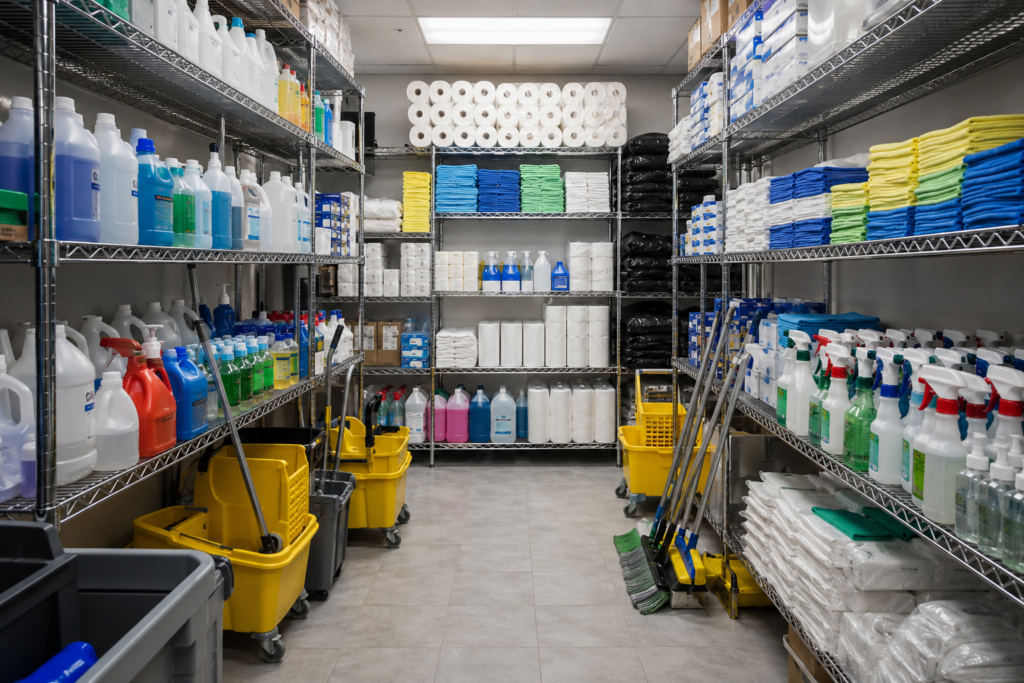
Build a Predictable Cleaning Supply Budget
Foxhole Depot offers wholesale case pricing on the janitorial supplies, cleaning chemicals, and restaurant supplies restaurants need to move from reactive retail purchasing to a predictable monthly supply budget. Visit the Wholesale Corner or contact sales@foxholedepot.com to set up recurring par-level ordering for your restaurant.