
Disposable vs. Reusable food service Supplies: A Decision Framework for Restaurants
Introduction
Every restaurant eventually faces the same recurring question, station by station: should this be disposable or reusable? Cleaning cloths, gloves, cups, cutting boards, aprons nearly every category of food service supply now comes in both forms, and the “right” answer isn’t the same for every station in the same kitchen. A raw-poultry prep station and a front-of-house coffee bar have completely different risk profiles, labor considerations, and cost structures, even though they’re part of the same restaurant.
This guide gives operators a practical decision framework not a blanket rule for choosing disposable versus reusable supplies category by category, based on hygiene risk, labor cost, purchasing cost, and operational volume.
Table of Contents
- Executive Summary
- Direct Answer: How to Decide
- Deep Educational Content: The Real Trade-Offs
- Category-by-Category Decision Guide
- Commercial Buying Guide
- Restaurant Use Cases
- Janitorial Use Cases
- Industry Examples
- Comparison Tables
- Pros & Cons
- Expert Tips
- Common Mistakes
- Cost Analysis
- Product Selection Guide
- Frequently Asked Questions
- Conclusion
Executive Summary
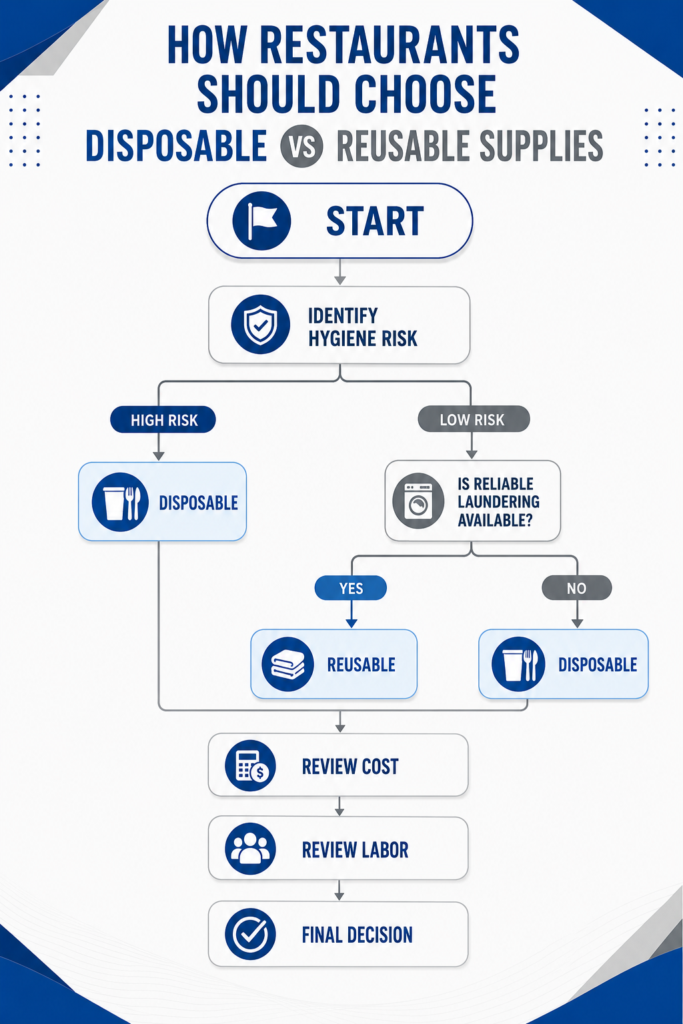
There is no universal answer to “disposable or reusable” the right choice depends on the specific station’s hygiene risk, the restaurant’s labor capacity for laundering or washing, purchase volume, and how much cross-contamination risk a reusable item introduces if not laundered correctly. High-risk stations (raw protein prep, allergen-free prep) generally favor disposable products regardless of cost, because the cost of a single contamination incident outweighs the savings from reuse. Lower-risk, high-frequency-use categories (general floor cleaning, front-of-house wiping) are often better served by reusable microfiber, provided the restaurant has reliable in-house laundering.
Direct Answer: How Should a Restaurant Decide?
A restaurant should decide between disposable and reusable supplies by evaluating four factors for each specific use case: hygiene risk (how bad is a contamination failure at this station), labor capacity (does the restaurant have reliable laundering or washing systems), purchase volume (does case-based disposable purchasing offer meaningful cost savings at this volume), and operational consistency (can staff be trusted to follow reuse protocols correctly under rush conditions). High-risk, high-turnover stations favor disposables; stable, lower-risk, high-frequency general cleaning tasks often favor reusable.
Deep Educational Content: The Real Trade-Offs
Hygiene Risk
Disposable products eliminate an entire category of risk: improper laundering. A reusable cloth or towel is only as safe as the laundering process behind it if colors get mixed, temperatures aren’t hot enough, or laundering is delayed, a “clean” reusable cloth can actually reintroduce contamination. Disposable products sidestep this entirely by being used once and discarded, which is why high-risk stations (raw poultry, raw seafood, allergen-free prep) most often default to disposable regardless of cost.
Labor and Operational Reality
Reusable products only deliver their cost advantage if the labor and equipment to properly launder them exists and is reliably used. A restaurant without dedicated laundering capacity, or one where laundering gets deprioritized during busy periods, often ends up functionally treating reusable items as disposable anyway using them once, setting them aside, and eventually discarding rather than properly re-laundering which erases the cost benefit entirely.
Purchase Volume and Waste Stream
High-volume single-use categories, like paper cups, hot cup lids, and takeout containers, are inherently disposable by design and the “reusable” comparison doesn’t apply in the same way the real decision there is between disposable material types (paper vs. plastic vs. compo-stable), not disposable vs. reusable.
Category-by-Category Decision Guide
| Category | Generally Favor | Why |
|---|---|---|
| Raw protein prep cloths | Disposable | Eliminates laundering cross-contamination risk at highest-risk stations |
| Allergen-free prep cloths/boards | Disposable or dedicated reusable, never shared | Cross-contact risk is too high for shared reusable rotation |
| General floor mopping | Reusable | High reuse volume with reliable laundering makes this cost-effective |
| Front-of-house table wiping | Either, based on volume | High-turnover concepts often favor disposable for speed and consistency |
| Restroom cleaning cloths | Disposable | Low cost per use, eliminates cross-zone laundering risk |
| Gloves | Disposable (standard practice) | Reusable gloves are not standard or recommended for food-contact tasks |
| Aprons | Reusable (laundered) | Lower turnover need, cost-effective with standard laundry service |
| To-go cups, lids, containers | Inherently disposable | Decision is about material (paper/plastic/compo-stable), not reuse |
Commercial Buying Guide
- Segment your kitchen by risk tier first. Identify which stations handle raw protein, allergens, or high-volume turnover before deciding on product type station by station.
- Match disposable purchasing to actual usage volume. Buying disposable cloths in case quantities that match daily usage avoids both shortages and overstock.
- Invest in reusable only where laundering is reliable. If your restaurant doesn’t have consistent access to commercial laundering (in-house or contracted), default to disposable for cloths and towels regardless of theoretical cost savings.
- Standardize color-coding across both disposable and reusable items if using a mixed system, so staff aren’t tracking two separate visual systems.
- Reassess annually as volume changes. A concept that scales up significantly may cross the volume threshold where investing in reusable systems and laundering equipment becomes more cost-effective than continuous disposable purchasing.
Restaurant Use Cases
- High-volume quick-service restaurants typically favor disposable cloths and gloves throughout, prioritizing speed and consistency over the labor investment reusable systems require.
- Full-service restaurants with slower table turns often use reusable cloths for general front-of-house cleaning while reserving disposables for kitchen prep stations handling raw protein.
- Bakeries and allergen-conscious kitchens should default to disposable or strictly dedicated (never shared) reusable tools for allergen-free production, given the severity of allergic cross-contact incidents.
- Catering operations frequently favor disposable across the board due to off-site work where laundering infrastructure isn’t available.
Janitorial Use Cases
- Contract janitorial services often standardize on reusable microfiber for general facility cleaning since they control the laundering process centrally across multiple client sites, capturing the cost benefit that individual restaurants without laundering infrastructure can’t.
- In-house overnight cleaning crews without dedicated laundering support are frequently better served by disposable cloths for kitchen and restroom tasks, since inconsistent laundering undermines the hygiene benefit reusable are supposed to provide.
- Facilities managing multiple restaurant locations may run a hybrid model — reusable for centrally laundered items, disposable for anything handled inconsistently at the individual site level.
Industry Examples
Large multi-unit food service operators increasingly run hybrid systems rather than an all-disposable or all-reusable approach using disposable products at the highest-risk points in the kitchen (raw protein handling, allergen prep) while relying on reusable, centrally laundered systems for lower-risk, high-frequency general cleaning tasks. This segmented approach reflects the actual cost-benefit reality better than a single blanket policy, and it’s increasingly the standard recommended by food service operations consultants working with growing restaurant groups.
Comparison Tables
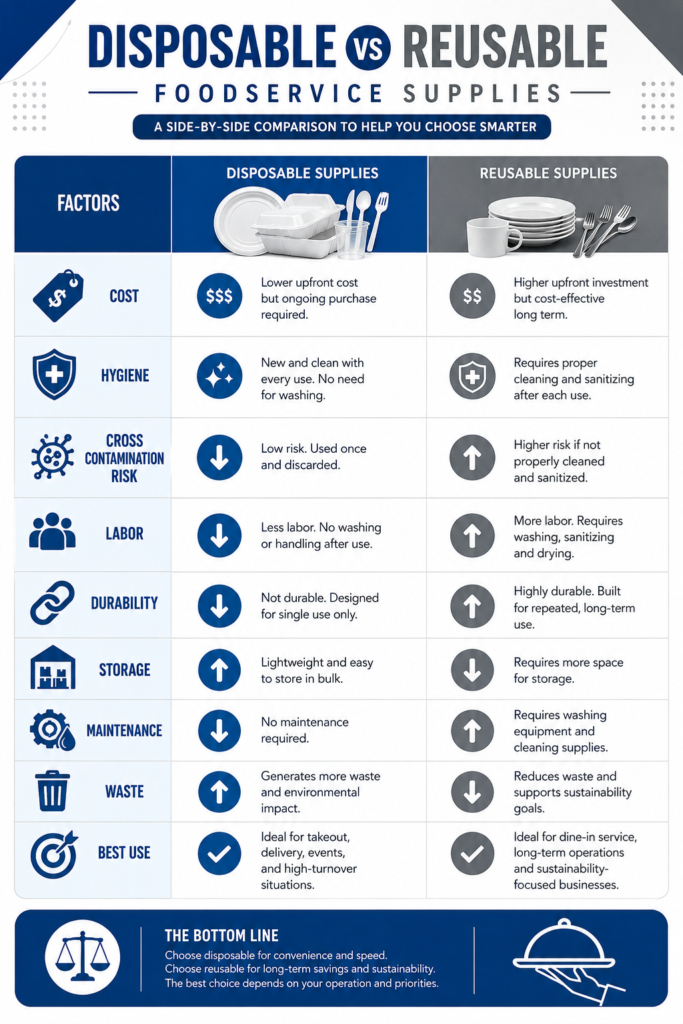
Disposable vs. Reusable: Core Trade-Offs
| Factor | Disposable | Reusable |
|---|---|---|
| Upfront cost | Lower per unit | Higher per unit |
| Recurring cost | Continuous purchase | Lower recurring cost if laundered reliably |
| Cross-contamination risk | Eliminated (single use) | Depends entirely on laundering reliability |
| Labor requirement | None | Requires laundering time/equipment |
| Best fit | High-risk stations, inconsistent staffing, off-site work | Stable operations with reliable in-house or contracted laundering |
| Waste stream impact | Higher, continuous disposal | Lower, if properly maintained over its usable life |
Decision Matrix by Risk and Volume
| Risk Level | Low Volume | High Volume |
|---|---|---|
| High hygiene risk (raw protein, allergens) | Disposable | Disposable |
| Low hygiene risk (general surfaces) | Either works | Reusable often more cost-effective at scale |
Pros & Cons
Disposable Supplies
- Pros: Eliminates laundering-related cross-contamination risk, no labor investment, consistent quality every use
- Cons: Higher continuous purchase cost at scale, larger ongoing waste stream
Reusable Supplies
- Pros: Lower cost per use over time (when properly laundered), smaller waste stream
- Cons: Entirely dependent on reliable laundering; hygiene risk if that reliability breaks down, upfront cost, labor requirement
Expert Tips
- Never default to reusable for a station simply because it’s “always been that way” reassess based on actual risk and laundering reliability, not habit.
- If in doubt about laundering consistency, default to disposable the cost of a contamination incident vastly outweighs the marginal savings from reuse.
- Track disposable usage per station monthly to catch overuse trends before they inflate cost unnecessarily.
- For allergen-free prep, treat “disposable or strictly dedicated reusable, never shared” as a hard rule, not a judgment call left to individual staff.
- Revisit the disposable/reusable mix any time your restaurant’s volume, staffing model, or laundering access changes significantly.
Common Mistakes
- Using reusable cloths at high-risk stations without a laundering system reliable enough to actually deliver the hygiene benefit
- Treating the disposable-vs-reusable decision as all-or-nothing across the entire kitchen instead of station-by-station
- Underestimating labor cost when calculating “savings” from switching to reusable products
- Sharing allergen-designated reusable tools across multiple food categories, defeating the purpose of dedicating them
- Overbuying disposable case volume that doesn’t match actual daily usage, tying up cash in excess inventory
Cost Analysis
| Item | Disposable (Cost per Use, Approx.) | Reusable (Cost per Use, Approx., Assuming Reliable Laundering) |
|---|---|---|
| Cleaning cloth | $0.08–$0.20 | $0.03–$0.10 (including laundering cost) |
| Cutting board (single-use liner vs. board) | Varies by category | Lower long-term if properly maintained |
| Gloves | $0.02–$0.05 per pair | Not standard practice for food-contact tasks |
The reusable cost advantage only holds when laundering is consistent restaurants with unreliable laundering access often find their real effective cost per use for “reusable” items exceeds disposable once losses, discards, and inconsistent reuse are factored in.
Product Selection Guide
- For high-risk food-contact stations, select disposable food service cloths and gloves as the default, regardless of cost differential.
- For general facility cleaning with reliable laundering, invest in quality reusable microfiber, which typically outlasts and outperforms lower-grade reusable alternatives over its usable life.
- For allergen-designated tools, purchase a distinctly colored, clearly labeled set disposable or strictly dedicated reusable separate from the general rotation.
- For off-site and catering work, default to disposable across the board given the lack of laundering infrastructure on location.
- Buy case-pack sizes matched to actual per-station usage volume, tracked separately by station rather than as one blended kitchen-wide estimate.
Frequently Asked Questions
Are disposable or reusable cleaning cloths safer in a restaurant? Disposable cloths eliminate laundering-related cross-contamination risk entirely, making them the safer default for high-risk stations. Reusable cloths can be equally safe, but only if laundering is consistently reliable — which not every operation has in place.
Is it cheaper to use reusable cleaning supplies? Reusable supplies are often cheaper per use over time, but only when laundering is handled reliably. If laundering is inconsistent, the effective cost per use of reusable items can exceed disposable once losses and improper reuse are accounted for.
Should allergen-free prep use disposable or reusable tools? Allergen-free prep should use either disposable tools or strictly dedicated reusable tools that are never shared with other food categories shared reusable tools introduce unacceptable cross-contact risk for allergen-sensitive customers.
Do quick-service restaurants typically use more disposables than full-service restaurants? Yes, generally. Quick-service concepts favor disposables for speed, consistency, and staffing model reasons, while full-service restaurants with more stable staffing and slower turns more often incorporate reusable products for general cleaning tasks.
How does a restaurant decide between disposable and reusable at a specific station? Evaluate hygiene risk, labor/laundering reliability, purchase volume, and staffing consistency at that specific station the decision should be made station by station, not as a single blanket policy for the whole kitchen.
Conclusion
The disposable-versus-reusable question isn’t a single decision a restaurant makes once it’s a framework applied station by station, based on real hygiene risk and real operational capacity, not habit or assumption. High-risk stations should default to disposable regardless of cost; lower-risk, high-frequency general cleaning tasks can often benefit from reusable systems, but only where laundering reliability genuinely supports the hygiene claim reusable products depend on.
Stock Both Without Compromising on Either
Foxhole Depot carries both disposable cleaning cloths and general janitorial supplies at wholesale case pricing, so restaurants can build the right disposable-and-reusable mix station by station rather than defaulting to one system across the whole kitchen. Contact sales@foxholedepot.com to build a supply plan tailored to your kitchen’s risk profile and volume.