
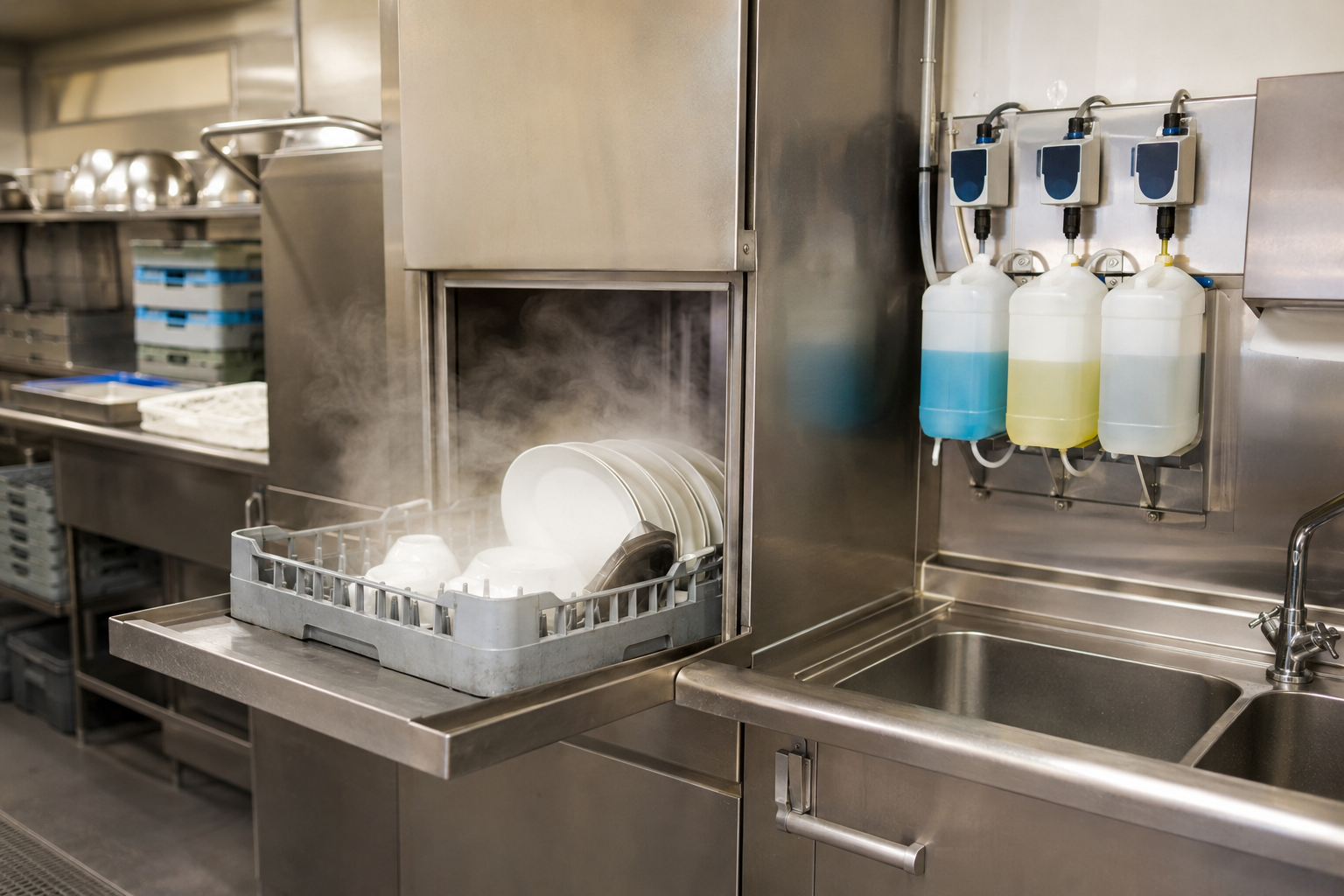
A commercial dish machine only works as well as the chemicals running through it. If your glasses come out spotted, your plates still feel greasy, or your detergent capsule runs out halfway through a shift, the fix usually isn’t a new machine it’s the wrong detergent, rinse aid, or sanitizer for your water and equipment. Here’s how to match each one to your kitchen.
The Three Chemicals Every Dish Machine Needs
A commercial ware-washing system depends on three products working together, not one “do-it-all” chemical:
- Detergent: breaks down grease, food residue, and film during the wash cycle.
- Rinse aid: reduces water spotting and speeds up drying during the final rinse.
- Sanitizer (low-temp machines only): kills bacteria when the machine can’t reach a high enough water temperature to sanitize on its own.
High-temperature machines sanitize using hot water (usually a 180°F final rinse), so they typically only need detergent and rinse aid. Low-temperature machines rely on a chemical sanitizer instead, since their final rinse doesn’t get hot enough to sanitize on its own that’s a compliance requirement, not an optional add-on.
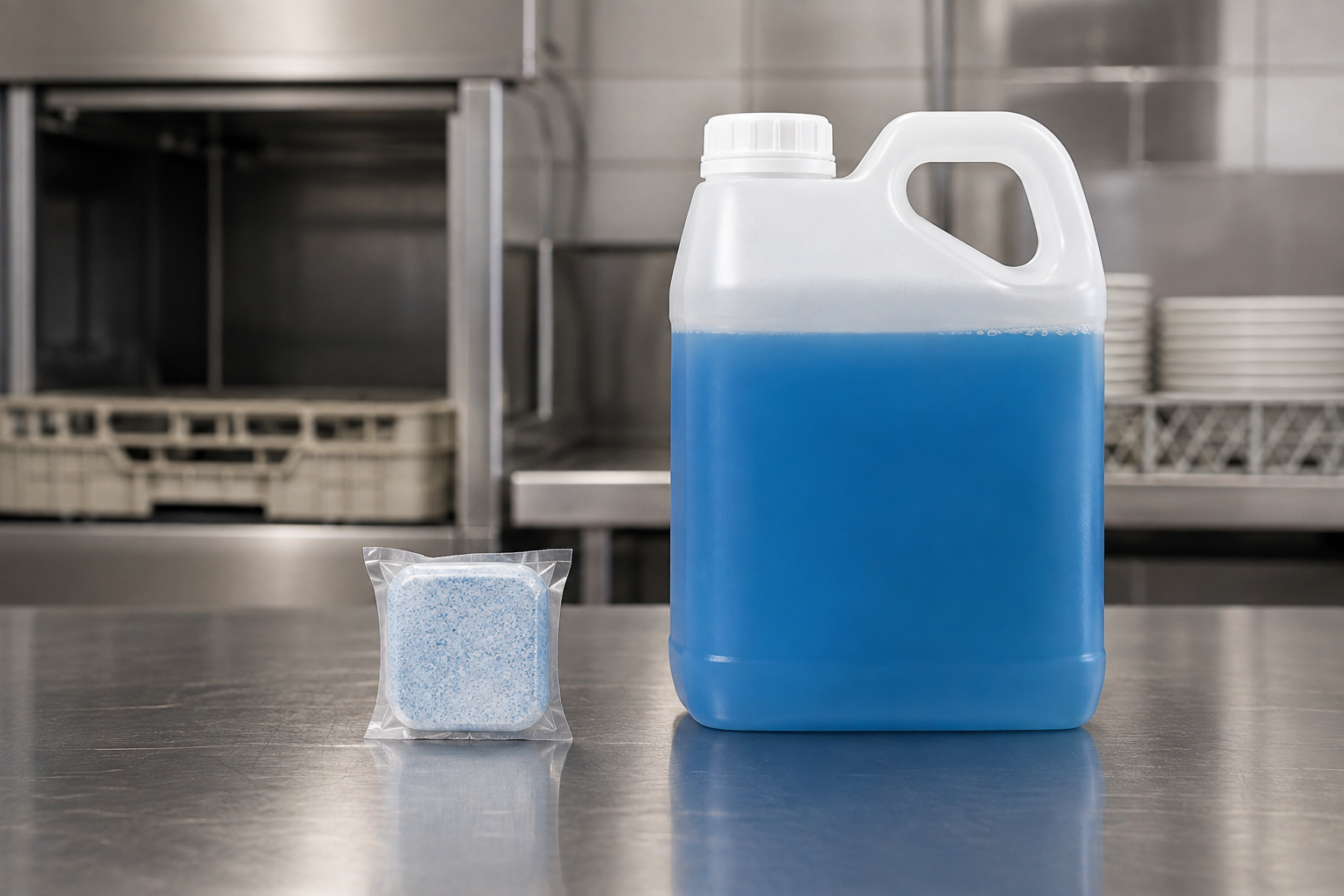
Solid vs. Liquid Detergent: Which One Fits Your Kitchen?
Both formats clean effectively; the right choice usually comes down to volume and storage rather than performance.
| Solid Detergent | Liquid Detergent | |
|---|---|---|
| Best for | High-volume kitchens with a capsule dispenser | Kitchens without a solid dispenser system |
| Dosing | Pre-measured per capsule less guesswork | Requires a calibrated liquid dispenser |
| Storage | Compact, stack-able capsules | Takes up more shelf space, heavier to lift |
| Hard water performance | Often includes a built-in descaling agent | Varies by formula check the label |
If your kitchen deals with hard water, look specifically for a detergent with a descaling agent built in it reduces the mineral buildup that causes cloudy glassware and film on plates over time. Noble Chemical’s Power Green solid dish machine detergent is a phosphate-free solid option built for exactly this kind of heavy-duty commercial use.
Why Rinse Aid Matters More Than Most Operators Realize
Detergent cleans; rinse aid is what actually gets you a spot-free, dry finish. Without it, water beads and dries unevenly on glass and china, leaving the streaks and spots that make even clean dishes look dirty. Rinse aid also speeds up drying time, which matters during a fast-turnover dinner rush when your team is re-racking glassware every few minutes.
For kitchens dealing with hard water specifically, Noble Chemical’s Dry It HD premium rinse aid is formulated to work in all water conditions and is designed for automatic dispensing systems, so it’s a straightforward drop-in for most existing setups.
Sanitizer: Required for Low-Temp Machines
If your dish machine is a low-temperature unit, a chemical sanitizer isn’t optional it’s how your final rinse actually meets food-safety requirements. Noble Chemical’s Low Temp San sanitizer is built specifically for low-temperature machines with a minimum final rinse temperature around 120°F, and it’s designed to hook directly into your existing dispensing system.
What About General Kitchen Degreasing and Polishing?
Dish machine chemicals handle what goes through the machine but back-of-house surfaces, floors, and cookware need their own products:
- General degreasing (floors, prep surfaces, equipment exteriors): a citrus-based solvent cleaner like Noble Chemical’s Orange Peel citrus solvent cleaner cuts grease without the harsh fumes of some traditional solvents.
- Pots, pans, and stainless steel cookware that can’t go through a dish machine: Bar Keepers Friend cookware cleansing and polishing powder handles baked-on residue and restores shine on stainless and other hard surfaces.
A Simple Way to Diagnose Common Problems
| Symptom | Likely Cause | Fix |
|---|---|---|
| Cloudy or spotted glassware | Hard water, no rinse aid, or wrong rinse aid | Add or upgrade rinse aid formulated for hard water |
| Greasy film on plates | Detergent under-performing for soil load | Switch to a heavier-duty detergent or check dosing |
| Slow drying between racks | Rinse aid dosage too low or missing entirely | Check dispenser calibration; confirm rinse aid is connected |
| Failed sanitation check (low-temp machine) | Sanitizer not connected or under-dosed | Verify sanitizer dispenser and confirm final rinse temp |
Choosing a Starting Setup
For most standard commercial kitchens, a solid workflow looks like: a solid or liquid detergent matched to your soil load and water hardness, a rinse aid rated for your water conditions, and for low-temp machines only a compatible chemical sanitizer. From there, general degreaser and cookware polish round out the rest of the kitchen. Getting this combination right the first time saves you from cycling through products by trial and error, and keeps your kitchen consistently passing sanitation checks.
FAQ
How often should dish machine rinse aid be refilled? It depends on wash volume, but most commercial kitchens check rinse aid levels daily and refill on a set schedule rather than waiting for it to run out mid-shift, since a dry rinse aid line means immediate spotting on glassware.
Can I use the same chemicals in a high-temp and low-temp dish machine? Detergent and rinse aid are generally interchangeable across both machine types, but sanitizer is not low-temp machines require a chemical sanitizer that high-temp machines don’t need, since high-temp machines sanitize using hot water instead.
Why do my glasses still look cloudy even with rinse aid? This is usually a hard water issue rather than a rinse aid failure look for a rinse aid and detergent specifically formulated for hard water, and confirm your dispenser is actually dosing correctly rather than running low.
Is solid or liquid detergent better for a busy kitchen? Neither is inherently “better” solid detergent offers more consistent, pre-measured dosing with less storage space, while liquid detergent can be easier to scale up or down for kitchens without a solid dispenser system already installed.